SSC CGL 2026 Syllabus: Complete Tier-I and Tier-II Breakdown
Once the exam dates and application process are sorted, the next big question every CGL aspirant asks is: what exactly do I need to study? SSC has laid out a detailed indicative syllabus for both tiers in the official notification. Here's the complete breakdown, along with the sectional timing you'll be racing against on exam day.
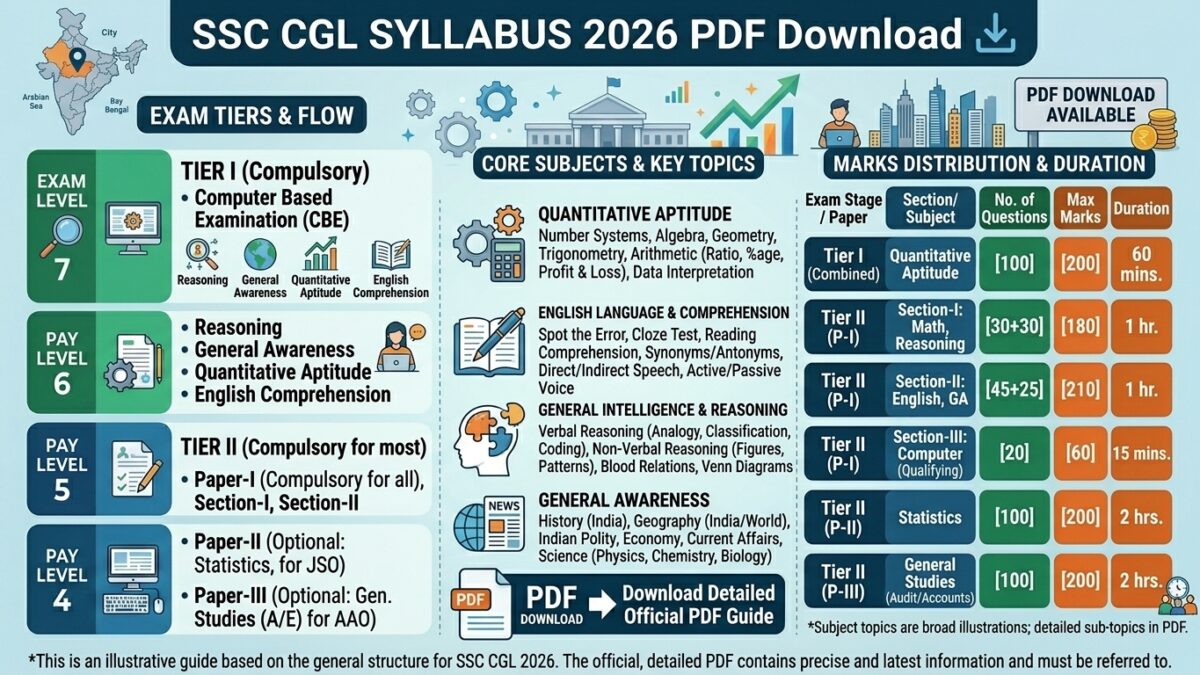
A visual overview of the SSC CGL examination structure and syllabus.
Tier-I Syllabus
Tier-I has four sections, 25 questions each, and every section runs on its own 15-minute sectional timer within the overall 1-hour paper (1 hour 20 minutes for scribe-eligible candidates).
| Section | Topics |
|---|---|
| A. General Intelligence & Reasoning | Analogy (Semantic, Symbolic/Number, Figural) • Classification • Series • Coding-Decoding • Numerical & Symbolic Operations • Problem Solving • Word Building • Space Orientation & Visualization • Venn Diagrams • Drawing Inferences • Pattern folding/unfolding & completion • Embedded Figures • Critical, Emotional & Social Intelligence |
| B. General Awareness | Current events • Everyday science • India & neighbouring countries — History, Culture, Geography, Economic Scene, General Policy, Scientific Research |
| C. Quantitative Aptitude | Numbers, decimals, fractions • Percentage, Ratio & Proportion, Averages • Interest, Profit & Loss, Discount • Partnership, Mixture & Alligation • Time & Distance, Time & Work • Algebra (identities, surds, linear graphs) • Geometry • Mensuration • Trigonometric ratios • Histogram, Bar & Pie Chart |
| D. English Comprehension | Correct English usage • Comprehension • Basic writing ability |
Difficulty level: Sections A, B & D are at graduation level; Section C (Quant) is at 10th-standard level.
Tier-II Syllabus
Tier-II is split into Paper-I (compulsory for all posts), Paper-II (Statistics — only for JSO/Statistical Investigator posts), and Paper-III (Finance & Economics — only for AAO/AAO Cadre posts), conducted in separate sessions on the same day.
Paper-I — Session-I (2 hours 15 minutes total)
Section-I: Mathematical Abilities + Reasoning & General Intelligence
1 hour total, sectional timer of 30 minutes per part
| Part | Topics |
|---|---|
| Mathematical Abilities | Number Systems • Arithmetic (Percentages, Ratio, Interest, Profit-Loss, Time-Work) • Algebra • Geometry • Mensuration (2D & 3D) • Trigonometry • Statistics & Probability (mean/median/mode, standard deviation, simple probability) |
| Reasoning & General Intelligence | Same verbal/non-verbal topics as Tier-I — analogy, classification, series, coding-decoding, Venn diagrams, pattern folding, critical/emotional/social intelligence |
Section-II: English Language & Comprehension + General Awareness
1 hour total, sectional timer of 40 minutes (English) and 20 minutes (GA)
| Part | Topics |
|---|---|
| English Language | Vocabulary, grammar, sentence structure • Synonyms/Antonyms • Spot the Error, Fill in the Blanks • Idioms & Phrases • Active/Passive Voice, Narration • Cloze Passage • Comprehension |
| General Awareness | Same India & neighbourhood-focused current affairs and static GK as Tier-I |
Section-III: Computer Knowledge Test (Qualifying)
15 minutes
- Computer basics: CPU, I/O devices, memory, ports
- MS Office basics (Word, Excel, PowerPoint)
- Internet & email usage, e-Banking
- Networking & cyber-security fundamentals
Paper-I — Session-II
Section-IV: Data Entry Speed Test — a 2,000-key-depression passage in 15 minutes (qualifying, mandatory for most posts).
Paper-II — Statistics (2 hours)
Required only for JSO/Statistical Investigator
Data Collection, Classification & Presentation • Measures of Central Tendency & Dispersion • Moments, Skewness & Kurtosis • Correlation & Regression • Probability Theory • Random Variables & Distributions • Sampling Theory • Statistical Inference (Z/t/Chi-square/F tests) • Analysis of Variance • Time Series Analysis • Index Numbers
Paper-III — General Studies (Finance & Economics) (2 hours)
Required only for AAO posts
- Part A: Finance & Accounts (80 marks): Financial Accounting principles, double entry, trial balance, P&L, Balance Sheet, Depreciation, non-profit accounts.
- Part B: Economics & Governance (120 marks): C&AG role, Finance Commission, Micro-economics fundamentals, Demand-Supply theory, Market forms, Indian Economy (sectors, poverty, infrastructure), Economic reforms since 1991, Money & Banking (RBI, fiscal policy).
Why Calculation Speed Actually Matters
Look closely at the timing structure above and one thing stands out: every section is sealed off with its own clock. You can't borrow time from Reasoning to finish off a tricky Quant question, and in Tier-II's Section-I, Mathematical Abilities and Reasoning share a single 1-hour window with no flexibility to shift time between them once it's allotted per subject.
This is exactly where calculation speed becomes a scoring factor, not just a convenience. With sectional timers this tight, every second spent on long division, manual percentage conversion, or squaring numbers by hand is a second taken directly from questions you could have solved. Aspirants who've built strong mental-math reflexes—squares, cubes, percentage-fraction conversions, quick approximations—consistently finish Quant sections with time to revisit doubtful questions, while those still calculating from scratch often can't even attempt the last few questions before the timer cuts them off.
In short: syllabus coverage gets you the concepts, but calculation speed is what lets you actually convert that knowledge into attempted, correct answers within the sectional time limit.
Build Your Calculation Speed
If mental calculation is your weak spot, Mark for Review's Calc Drill tool is built specifically to fix that. Practice squares, cubes, percentages, and quick arithmetic against the clock—the exact same way you'll face it in the actual sectional-timed exam.
Try Calc Drill Now